


The goal, during the process over the years, with Rafael Leão was very specific and simple, to make the athlete as strong as possible to be decisive in the actions of explosive force and vertical speed within the game. Some essential aspects in our Periodization over the years are: Intermuscular Coordination, Intramuscular Coordination, The recruitment of the Maximum Number of Motor Units, IMCA Acceleration Patterns, Synchronisation of Motor Units, Acceleration of the Recovery Processes, Controlling Nutritional Levels, Reducing Inflammation Levels and finally Increasing the confidence levels of the athlete. Periodisation is the cyclical division of a training program into individual training phases to maximise training success. It simply means regularly varying your training program and individual training parameters, such as repetitions, sets, tempo, and rest, in order to ensure constant progress. There are different types of periodisation. Here we are going to focus in undulating periodisation and conjugated periodisation. Recent scientific evidence argues that there are 3 main mechanisms responsible for muscle hypertrophy: Mechanical Tension – Active: Contraction of a muscle fibre during the contraction of its motor units before a source of external resistance. Passive: Stretching of muscle fibres caused by an external force or an eccentric contraction. Both forms originate muscle anabolic signalling pathways through their respective mechanoreceptors. Maximised with loads around 85%-100% of our RM. Metabolic Stress – Effect of the accumulation of metabolites (such as lactate, hydrogen ions and inorganic phosphate) on muscle fibres. This phenomenon occurs mostly in workouts with medium-high number of repetitions or in which blood flow restriction occurs (caused deliberately or due to constant tension) Maximised with low to moderate loads and high volumes (and short rest intervals) Muscle Damage – Muscle damage involves damage to the muscle fibres themselves, whether in myofibrils, cytoskeleton, sarcolemma or extracellular matrix. This phenomenon causes an inflammatory response, and thus the fibre regeneration process. Maximised with moderate loads and volume. With this purchase you’ll get the e-book downloadable version.
SHOP
Sale!
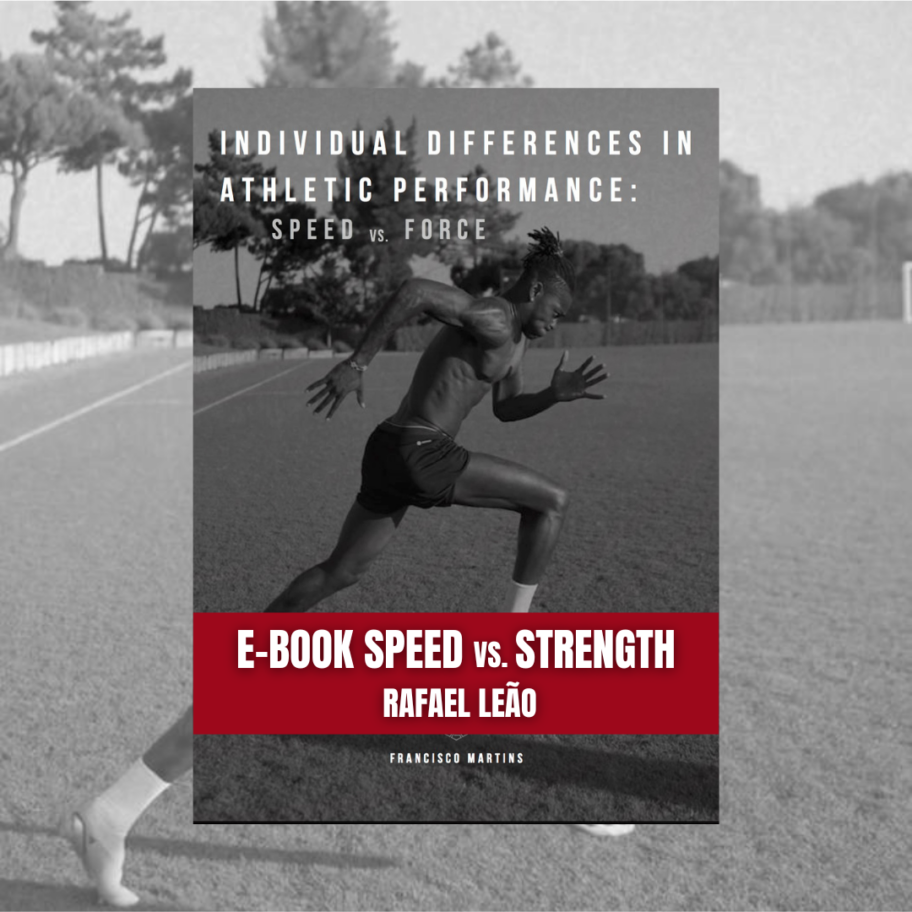
E-book Rafael Leão Speed vs. Strength
Original price was: 100,00€.75,00€Current price is: 75,00€.
